During the average recovery since World War II, gross domestic product (GDP) surpassed the pre-recession high five quarters after the recession began. It has never taken longer than seven quarters. Yet today, after 11 quarters, GDP is still below what it was in the fourth quarter of 2007. The economy is growing at only about a third of the rate of previous postwar recoveries from major recessions. Obama administration officials such as Treasury Secretary Tim Geithner have argued that without their policies the economy would be worse, and we might have fallen "off a cliff." While this assertion cannot be tested, we can compare the recent experience of other countries to our own. ...There are 4.6% fewer people employed in the U.S. today than at the start of the recession. Euro zone countries have lost 1.7% of their jobs. ...This simple comparison suggests...that American economic policy has been less effective in increasing employment than the policies of other developed nations. ...While the most recent quarterly growth figures are just a snapshot in time, it is hardly encouraging that economic growth in the U.S. (1.7%) is lower than in the euro zone (4%), U.K. (4.8%), G-7 (2.8%) and OECD (2%).
Showing posts with label Rankings. Show all posts
Showing posts with label Rankings. Show all posts
Monday, October 4, 2010
Obama's Policy Failure, Part I
Former Senator Phil Gramm had a column last week in the Wall Street Journal that deserves two blog posts. This first post highlights Gramm's analysis showing that the U.S. has been very Keynesian compared to Europe, with numerous efforts to jump start the economy with deficit spending. But Senator Gramm hits the nail on the head, comparing America's tepid recovery with the better performance across the Atlantic.

Thursday, September 16, 2010
Another Measure of American Decline
I don't know if this is hope or change, but the United States fell from 2nd to 9th in the Forbes index of "Best Countries for Business." Denmark is first, which may be a surprise, but the Scandinavian country is very free market other than fiscal policy. Hong Kong, meanwhile, enjoyed the biggest increase.
1. Denmark
2. Hong Kong
3. New Zealand
4. Canada
5. Singapore
6. Ireland
7. Sweden
8. Norway
9. United States
10. United Kingdom
The U.S. economy is teetering on the edge of a double-dip recession. High unemployment and a weak housing market are dragging down economic growth. But there's another major issue that isn't getting much attention these days: The business climate for entrepreneurs and investors in the U.S. is starting to lag behind other countries'. The U.S. dropped from No. 2 to No. 9 in our fifth annual ranking of the Best Countries for Business. Blame the high tax burden and a poor showing on trade and monetary freedom compared with many other developed nations. The 35% federal corporate tax rate is the highest of any OECD country according to the Tax Foundation. Meanwhile the government’s significant intervention in the economy during the economic downturn has weakened economic freedom in the U.S. ...A big mover up the rankings is Hong Kong, which swapped places with the U.S., moving up to No. 2 from No. 9. It scored in the top three for taxes, investor protection and both trade and monetary freedom.The Top 10
1. Denmark
2. Hong Kong
3. New Zealand
4. Canada
5. Singapore
6. Ireland
7. Sweden
8. Norway
9. United States
10. United Kingdom
Friday, September 10, 2010
America Drops to Fourth Place in Global Competitiveness Ranking
After being in 1st place in 2007 and 2008, America dropped behind Switzerland in the World Economic Forum's Global Competitiveness Report in 2009. The 2010 ranking was just released, and the United States has tumbled two more spots to 4th place, behind Switzerland, Sweden, and Singapore. I'm not a complete fan of the World Economic Forum's methodology (the Economic Freedom of the World rankings are the best measure of sound economic policy), but it's almost surely a bad sign when a country moves down in the rankings. The timing of the fall will lead some to blame Barack Obama, and I certainly agree that his policies are making America less competitive, but Bush also deserves blame for increasing the burden of government and compromising America's economic vitality. Here's a blurb from the Associated Press.
The U.S. has slipped down the ranks of competitive economies, falling behind Sweden and Singapore due to huge deficits and pessimism about government, a global economic group said Thursday. Switzerland retained the top spot for the second year in the annual ranking by the Geneva-based World Economic Forum. It combines economic data and a survey of more than 13,500 business executives. Sweden moved up to second place while Singapore stayed at No. 3. The United States was in second place last year after falling from No. 1 in 2008.
Wednesday, June 16, 2010
With Vermont Earning the Dubious Distinction of First Place, Northeastern States Dominate the Moocher Index
The Center for Immigration Studies recently put out a study arguing that immigration has had negative effects on California. One of their measures was a comparison of how many people in the state were receiving some form of welfare compared to other states. I found that data (see Table 3 of the report) very interesting, but not because of the immigration debate (I'll leave others to debate that topic). Instead, I wanted to get a better understanding of the variations in government dependency. Is there a greater willingness to sign up for income redistribution programs, all other things being equal, from one state to another? The "all other things being equal" caveat is very important, of course, since the comparison produced by CIS may simply be an indirect measure of the factors that determine welfare eligibility. One obvious (albeit crude) way of addressing this problem is to subtract each state's poverty rate to get a measure of how many non-poor people are signed up for income-redistribution programs. Let's call this the Moocher Index.
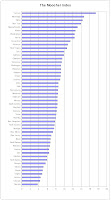 A few quick observations. Why is Vermont (by far) the state with the largest proportion of non-poor people signed up for welfare programs? I have no idea, but maybe this explains why they elect people like Bernie Sanders. But it's not just Vermont. Four of the top five states on the Moocher Index are from the Northeast, as are six of the top nine. Mississippi also scores poorly, coming in second, but many other southern states do well. Indeed, if we reversed the ranking and did a Self-Reliance Index, Virginia, Florida, and Georgia would score in the top 10. Nevada, arguably the nation's most libertarian state, is the state with the lowest number of non-poor people signed up for welfare.
Let's now emphasize several caveats. I'm not an expert on the mechanics of social welfare program, but even I know that eligibility is not governed solely by the poverty rate. Indeed, some welfare programs are open to people with much higher levels of income. This means that a more thorough analysis at the very least would have to include some measure of income distribution by state. Moreover, states use different formulas for Medicaid eligibility, so this index ideally also would be adjusted for state-specific policies that make it easier or harder for people to become dependent. There also are some states (and even colleges) that actually try to lure people into signing up for welfare, which also might affect the results. And I'm sure there are many other factors that are important, including perhaps immigration. If anybody knows of most substantive research in this area, please don't hesitate to share material.
 A few quick observations. Why is Vermont (by far) the state with the largest proportion of non-poor people signed up for welfare programs? I have no idea, but maybe this explains why they elect people like Bernie Sanders. But it's not just Vermont. Four of the top five states on the Moocher Index are from the Northeast, as are six of the top nine. Mississippi also scores poorly, coming in second, but many other southern states do well. Indeed, if we reversed the ranking and did a Self-Reliance Index, Virginia, Florida, and Georgia would score in the top 10. Nevada, arguably the nation's most libertarian state, is the state with the lowest number of non-poor people signed up for welfare.
Let's now emphasize several caveats. I'm not an expert on the mechanics of social welfare program, but even I know that eligibility is not governed solely by the poverty rate. Indeed, some welfare programs are open to people with much higher levels of income. This means that a more thorough analysis at the very least would have to include some measure of income distribution by state. Moreover, states use different formulas for Medicaid eligibility, so this index ideally also would be adjusted for state-specific policies that make it easier or harder for people to become dependent. There also are some states (and even colleges) that actually try to lure people into signing up for welfare, which also might affect the results. And I'm sure there are many other factors that are important, including perhaps immigration. If anybody knows of most substantive research in this area, please don't hesitate to share material.
Sunday, April 18, 2010
Clinton Was Much Better than Bush
Some of my posts spark debate between Bush supporters and Clinton fans, particularly on my Facebook page. I hate to burst anyone's bubble, but Clinton wins that contest hands down. I'm only talking about economic issues, to be sure, so I'm not looking to trigger any discussions about foreign policy or abortion.
Regarding economic issues, perhaps the key thing to understand is that there are many factors which determine economic freedom (which, of course, is related to growth and prosperity). Some people look at a high-profile issue such as taxes, and are tempted to rank Bush higher because he cut taxes in 2001 and 2003, whereas Clinton increased taxes in 1993 (he also cut taxes in 1997, but not as much as he raised them four years earlier).
But while Bush had a better record on taxes, he had a much worse record on spending. And as I wrote in the Washington Examiner a couple of years ago, Bush's record in other areas was more statist than Clinton's (and I was writing before the bailouts).
Perhaps the best way of showing the difference between Bush and Clinton is to examine the Economic Freedom of the World annual rankings. Not all the years are available, but the image below clearly shows that economic freedom rose during the Clinton years and fell during the Bush years.
 I'm no great fan of Bill Clinton, and I'll be the first to admit that many of the good things that happened under Clinton were the result of a GOP Congress (in the good old days before they were corrupted by compassionate conservatism). But also keep in mind that Clinton signed into law almost all of the good policies that were enacted during his reign. Likewise, Bush signed into law almost all of the bad policies that were enacted during his reign. If I'm choosing between the economic policies that were implemented by the previous two Presidents, the answer is obvious.
Friday, February 26, 2010
Europe Lags Behind
Since many of the politicians want America to be more like Europe (including full government-run healthcare), it's worth contemplating what that would mean for the economy. America today is richer than Western Europe. Indeed, per-capita living standards are about 30 percent higher in the United States - and that's according to the statists at the Paris-based Organization for Economic Cooperation and Development (see page 6 of this report). And we have been growing faster, which presumably should not be the case according to convergence theory (see Annex Table No. 1 of this OECD database). It also seems that Europe's economy is more likely to endure a double-dip recession. Bloomberg reports:
Europe’s economy may be coming unstuck from the global recovery as governments to the south of the region struggle to reverse budget deficits and consumers in the north pull back spending. After the 16-nation euro economy almost stagnated in the fourth quarter, data this week showed the weakness reaching into 2010. ...“Europe is where we see the biggest risk of a double dip at the global level,” said Julian Callow, chief European economist at Barclays Capital in London. “Europe has been lagging and we’ve continued to see better numbers in Asia and now the U.S.” ...“There are tentative signs that the U.S. economy may be pulling ahead from Europe,” Nelson said in a Feb. 23 report... “The sovereign debt crisis in Europe’s periphery reinforces drags on euro-area growth,” said Michael Saunders, an economist at Citigroup in London.Irwin Stelzer, meanwhile, writes in the Washington Examiner about the same topic:
Europeans are comparing their close-to-zero growth rate in the last quarter of 2009 with our almost-6 percent growth. ...We are growing and they are not. ...Large numbers of shops in London are shuttered, students see no prospect of work when they graduate, and businessmen are groaning under rising tax burdens.
Thursday, February 18, 2010
The Global Ranking that Really Matters
The United States may not have the freest economy in the world. And America may not be the best place to live. But we do have the most hotties, at least according to a poll of British travelers that was linked on Instapundit. Having done a bit of travel myself, I'd put Estonia at the top of the list for those who prefer blondes and Montenegro for those who prefer brunettes. But what do I know? Here's a report on the survey from the Daily Telegraph:
The United States, home to George Clooney and Jessica Simpson, came top in a poll of more than 5,000 globe-trotting Britons. In second place was Brazil while Spain, which boasts Hollywood actress Penelope Cruz as one of its natives, was third. Blonde, tanned surfers of Australia saw it voted into fourth place, while Italy came fifth. Sexy Swedes, such as model Victoria Silvstedt, helped it into sixth spot, but England only made it into seventh place in the poll. India was eighth, France ninth, and Canada finished off the top 10. ...A spokeswoman for www.OnePoll.com, which carried out the study, said: ''America has got a lot on offer and boasts some of the sexiest people on the planet.
Subscribe to:
Posts (Atom)

